Every experienced driver knows the sensation: crossing a subtle railroad track, turning into an inclined concrete driveway, or striking an expansion joint on an urban highway, only to feel a dull, metallic thud resonate through the floorboards and steering column. In the early stages, the noise is intermittent. It occurs only on specific road imperfections or under hard braking, prompting many motorists to brush it off as an aging vehicle simply settling into its years.
Treating suspension noise as a harmless acoustic nuisance is one of the most expensive mistakes an automotive owner can make. In modern chassis engineering, the steering and suspension assemblies operate as a high-precision kinetic chain. Components work together within millimeter-level tolerances to manage vehicle weight, absorb vertical road shocks, and maintain optimal tire contact patches. When a single pivot point degrades, the tight geometry governing your wheel angles begins to shift unpredictably under real-world driving conditions.
A quiet knocking sound under your vehicle is rarely an isolated problem; it is the early warning sign of dynamic toe and camber deflection. Left unaddressed, deteriorated pivot points place extreme stress on neighboring assemblies, accelerate wear on steering racks and tie rods, and destroy high-performance tires within a few thousand miles. Learning to isolate whether a sound originates from a split rubber bushing, a dry ball joint, or a bound strut mount bearing enables you to diagnose issues early, perform repairs safely, and protect your alignment investment long before metal-on-metal friction causes irreversible damage.
Identifying Rubber Bushing Degradation and Control Arm Deflection
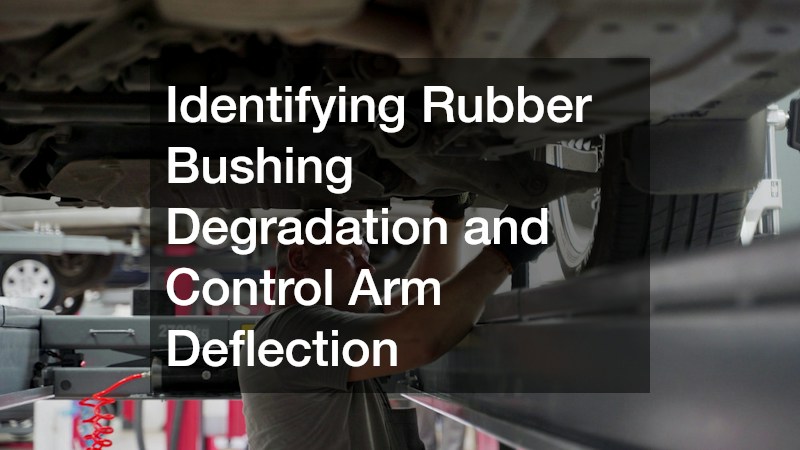
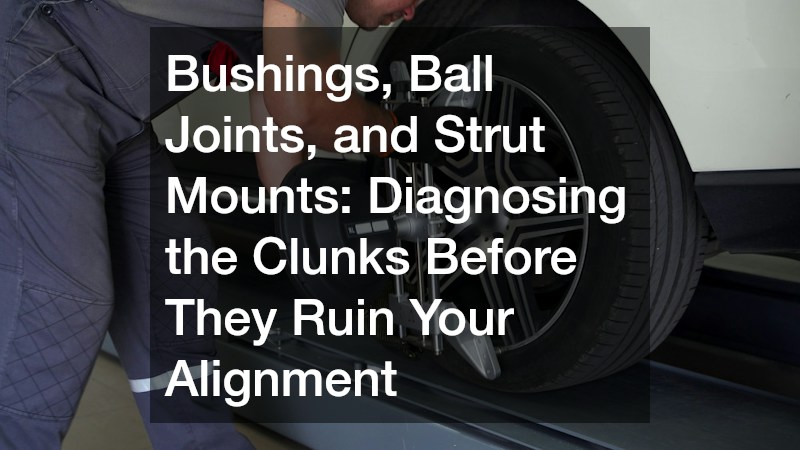
Suspension bushings serve as the quiet workhorses of automotive chassis architecture. Positioned at the critical mounting junctions where upper and lower control arms meet the subframe, these dense elastomeric sleeves fulfill two contradictory engineering mandates: they must isolate the passenger cabin from high-frequency roadway vibrations, and they must hold the suspension links firmly in place during aggressive cornering, heavy braking, and hard acceleration. When an engineer sets a vehicle’s static wheel alignment on a digital rack, that specification assumes the suspension bushings will maintain their factory geometry under dynamic roadway loads.
Over tens of thousands of miles, exposure to engine heat, road salts, automotive fluids, and environmental ozone takes a heavy toll on natural rubber compounds. Bushings gradually dry out, develop spiderweb surface cracks, and undergo deep radial tearing. In modern vehicles equipped with liquid-filled hydraulic bushings designed for enhanced ride compliance, a single structural tear allows internal damping fluid to escape, leaving behind a hollow rubber shell. Once this internal damping is lost, the control arm gains unwanted freedom to shift forward, backward, and laterally inside its mounting bracket.
When evaluating severe torsional suspension loads, commercial passenger vehicles present an extreme real-world stress test. Consider an extended-wheelbase limo, which carries substantial structural steel reinforcement, luxury interior appointments, and partition walls on top of a modified production chassis. The extreme curb weight of an extended vehicle places massive downward shear stress and lateral leverage on every subframe mount and trailing arm bushing, particularly during tight low-speed turns where the tires scrub across the asphalt.
For operators managing an active commercial limo service, proactive chassis maintenance is an operational imperative rather than an afterthought. If a front lower control arm bushing tears on a heavy passenger transport, the front wheels will splay outward during braking, causing the vehicle to dart unpredictably across roadway ruts and compromising passenger safety. Incorporating regular pry-bar inspections into standard maintenance schedules preserves ride comfort, prevents premature suspension rebuilds, and keeps commercial transport vehicles operating safely.
Diagnosing Worn Ball Joints and Steering Knuckle Play
While control arm bushings handle single-axis articulation, ball joints provide multi-axis rotational freedom. Constructed as a hardened steel ball encased within a greased spherical socket, the ball joint acts as the primary mechanical hinge connecting the control arm to the steering knuckle. It allows the front road wheels to steer left and right while the suspension simultaneously compresses and rebounds over rough pavement. Because ball joints frequently bear the entire corner weight of the vehicle, mechanical wear within this enclosed housing poses serious safety risks.
Ball joint wear begins when internal grease breaks down or the protective rubber dust boot tears. Once moisture, sand, and road grit penetrate the protective boot, the lubricant turns into an abrasive paste that rapidly scores the polished steel ball and tears away the internal nylon or bronze bearing race. As internal clearances widen, the stud develops radial and axial free play within the socket, producing a hollow, metallic knocking sound that is especially noticeable when traversing small, washboard road bumps at low speeds.
High-stress municipal fleet vehicles operate under some of the most aggressive suspension-loading cycles on the road today. Emergency pursuit vehicles, police interceptors, and tactical rescue SUVs frequently mount curbs, navigate unpaved shoulders, and execute high-speed maneuvers. When a front-line police cruiser outfitted with high-output emergency vehicle lights, siren amplifiers, ballistic door inserts, and heavy tactical gear travels over urban obstacles, the lower ball joints absorb extreme vertical impact loads. Catching early ball joint looseness in these severe-duty platforms prevents high-speed mechanical failures during critical emergency responses.
The danger of ignoring an advanced ball joint knock cannot be overstated. If a ball joint fails completely, the hardened steel stud pulls out of its socket entirely. When this happens, the steering knuckle breaks free from the control arm, causing the wheel assembly to fold horizontally into the fender well. This catastrophic failure instantly snaps the axle half-shaft, severs hydraulic brake lines, crushes the steering rack tie rod, and causes a total loss of steering control.
When a lower ball joint separates on a major thoroughfare, the vehicle cannot be driven or safely winched onto standard dollies. In these structural failure scenarios, roadside recovery specialists and contracted towing companies must deploy heavy-duty flatbed haulers equipped with low-approach slide beds, specialized lifting straps, and wheeled skates to extract the vehicle without ripping the damaged fender and rocker panels off the chassis. Addressing suspension clunks early prevents a simple component replacement from turning into an expensive, dangerous roadside extraction.
Isolating Strut Mount Bearings and Steering Spring Bind
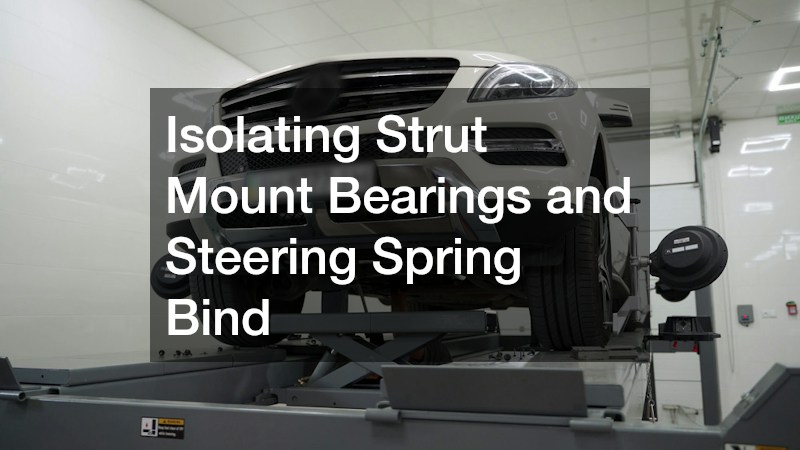
On vehicles fitted with MacPherson strut front suspensions, the upper mounting point represents another critical, yet frequently misdiagnosed, noise source. The upper strut mount, often referred to as the top-hat assembly, bolts into the vehicle’s structural sheet-metal strut tower. It consists of a thick vulcanized rubber isolator bonded around a central steel collar, housing a heavy-duty thrust bearing. This assembly carries the entire corner spring weight of the vehicle while allowing the MacPherson strut, coil spring, and steering knuckle to pivot smoothly around their steering axis.
Diagnosing upper strut mount problems requires distinguishing between two distinct mechanical failure modes: rubber deterioration within the mounting plate and seizure of the internal thrust bearing. When the bonded rubber isolator degrades, the upper piston rod of the shock absorber moves freely within the strut tower, producing a hollow, metallic rattling or thumping noise when driving over sharp roadway dips. Conversely, when the internal thrust bearing dries out, corrodes, or seizes, the strut assembly can no longer rotate freely as you turn the steering wheel.
In commercial haulers and freight fleets, isolating chassis and suspension noises is essential for daily fleet maintenance. Heavy cargo transports, delivery box vans, and medium-duty flatbeds encounter constant roadway vibrations that degrade kingpin bushings, leaf spring shackle mounts, and cab isolation dampeners. When maintenance managers coordinate scheduled truck repair services, evaluating upper shock mount bushings and cab isolators prevents minor steering binding from fatiguing expensive hydraulic power-steering gearboxes and drag links.
These specialized suspension demands are equally pronounced in custom experiential and entertainment vehicles. For instance, a commercial mobile gaming truck built on a heavy cab-over or cutaway chassis houses thousands of pounds of interior wall partitions, high-output electrical generators, multiple gaming consoles, and heavy climate systems. The continuous, uneven distribution of interior payload accelerates wear on upper strut isolators and leaf spring bushings. Technicians servicing these custom commercial conversions must routinely inspect upper suspension mounts to ensure that excessive body roll and suspension sagging do not compromise highway stability.
Preventing Irreversible Tire Wear and Dynamic Alignment Failure
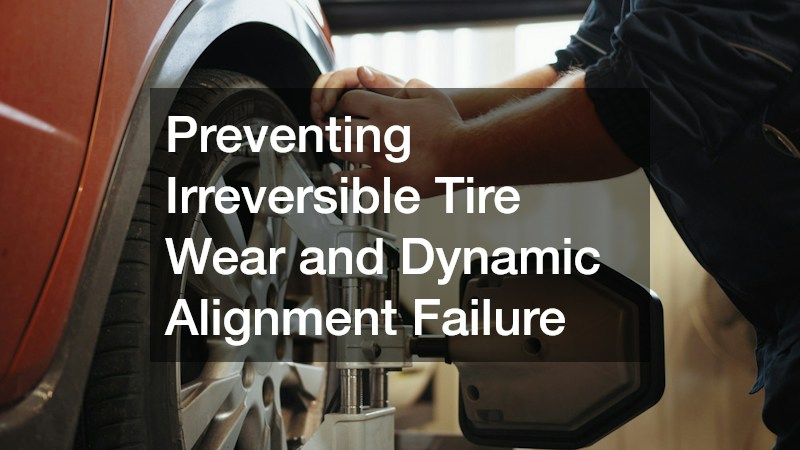
A common point of confusion for vehicle owners is how a mechanical suspension clunk relates to tire tread health. Many drivers assume that as long as their vehicle tracks relatively straight on a smooth highway, their wheel alignment remains acceptable. This assumption ignores the critical difference between static alignment, measured while a car sits motionless on an alignment lift, and dynamic alignment, which represents the actual geometry of the wheels as the vehicle accelerates, brakes, and turns.
Wheel alignment is defined by three primary geometric angles: camber (the vertical tilt of the tire inward or outward), caster (the forward or backward tilt of the steering axis), and toe (the inward or outward direction the tires point relative to the vehicle’s center line). While small camber shifts cause gradual wear over thousands of miles, an uncontrolled shift in toe angle will scrub the rubber off a tire at an alarming rate. Just one-eighth of an inch of dynamic toe error creates continuous scrubbing forces equivalent to dragging a tire sideways along the road for miles.
The financial consequences of unaddressed suspension play become obvious when you calculate the cost of replacement auto tires. Installing a brand-new set of high-performance all-season or touring tires on a vehicle with worn control arm bushings or loose ball joints will ruin that tire investment within three to five thousand miles. Even the most advanced computer-controlled four-wheel alignment rack cannot compensate for physical play in suspension links; the technician may set the lasers to green on the computer display, but the moment the vehicle backs off the alignment rack and taps the brakes, the dynamic toe angle swings out of spec.
Maintaining proper front-end alignment and tire longevity also requires monitoring under-hood accessory clearances and thermal conditions. In many compact and mid-size front-wheel-drive engine bays, the power steering lines, front suspension subframe mounts, and lower engine cradle brackets pass within inches of high-pressure refrigerant tubing and cooling components. When drivers notice weak cabin ventilation or squealing accessory belts, seeking prompt ac repair allows mechanics to inspect the accessory drive belt, compressor mounting brackets, and lower condenser seals. This coordinated approach ensures that leaking refrigerant oil or vibrating accessory pulleys do not drip onto and degrade the rubber suspension bushings resting directly below.
Executing Shop Repairs, Custom Fabrication, and Drivetrain Clearances

Once diagnostic procedures identify which suspension component has degraded, vehicle owners and mechanics must choose the most effective repair strategy. For ball joints and bushings, modern repair methods typically divide into two paths: replacing the entire control arm assembly with factory-installed bushings and ball joints already pressed in, or pressing individual wear components out of the existing control arm using hydraulic shop presses and specialty pullers.
While buying an entire replacement control arm is often faster for home mechanics working on driveway jack stands, commercial fleet garages and performance fabricators frequently press out degraded components to install heavy-duty, polyurethane, or greaseable aftermarket hardware. Executing this repair safely demands the correct tools and procedures:
In older vehicles, off-road builds, and heavy-duty utility platforms, years of continuous suspension impact can crack factory stamped brackets or tear the steel sway bar mounting tabs off the subframe. When this occurs, simply bolting on a new bushing is not enough; the underlying metal structure must be repaired and reinforced.
Professional repair shops keep dedicated welding supply inventory on hand, including high-purity argon-CO2 shielding gas, high-tensile ER70S-6 MIG wire, and laser-cut structural steel gusset plates. Using these supplies, skilled technicians can clean away road scale, box in weak factory control arms, and weld reinforced replacement tabs directly onto the chassis subframe, creating a mounting point stronger than the factory original.
Savvy technicians coordinate these deep structural tear-downs with major mechanical jobs like transmission replacements. When a worn automatic transaxle or dual-clutch gearbox must be pulled from the engine bay, the entire front subframe and steering assembly is lowered from the chassis. Refreshing worn lower control arm bushings, ball joints, and anti-roll bar end links while the crossmember sits accessible on a hydraulic work table saves hours of redundant labor down the road, ensuring the vehicle returns to the road with a refreshed drivetrain and a tight, responsive chassis.
A suspension knock is an early warning system built into your vehicle’s chassis. The components connecting your wheels to your frame communicate their condition through sound, vibration, and road feel long before catastrophic failure occurs. Choosing to listen to those subtle early signals protects your safety, maintains driving comfort, and prevents expensive collateral damage.
By taking the time to inspect degraded control arm bushings, test for worn ball joints, isolate seized strut mount bearings, and secure proper four-wheel alignments, you safeguard your vehicle against dynamic alignment drift and premature tire wear. A well-maintained suspension preserves the balance, responsive handling, and braking stability the original engineers designed into the vehicle. Address those minor clunks promptly, and you will enjoy a quiet, confident, and reliable driving experience wherever the road leads.